
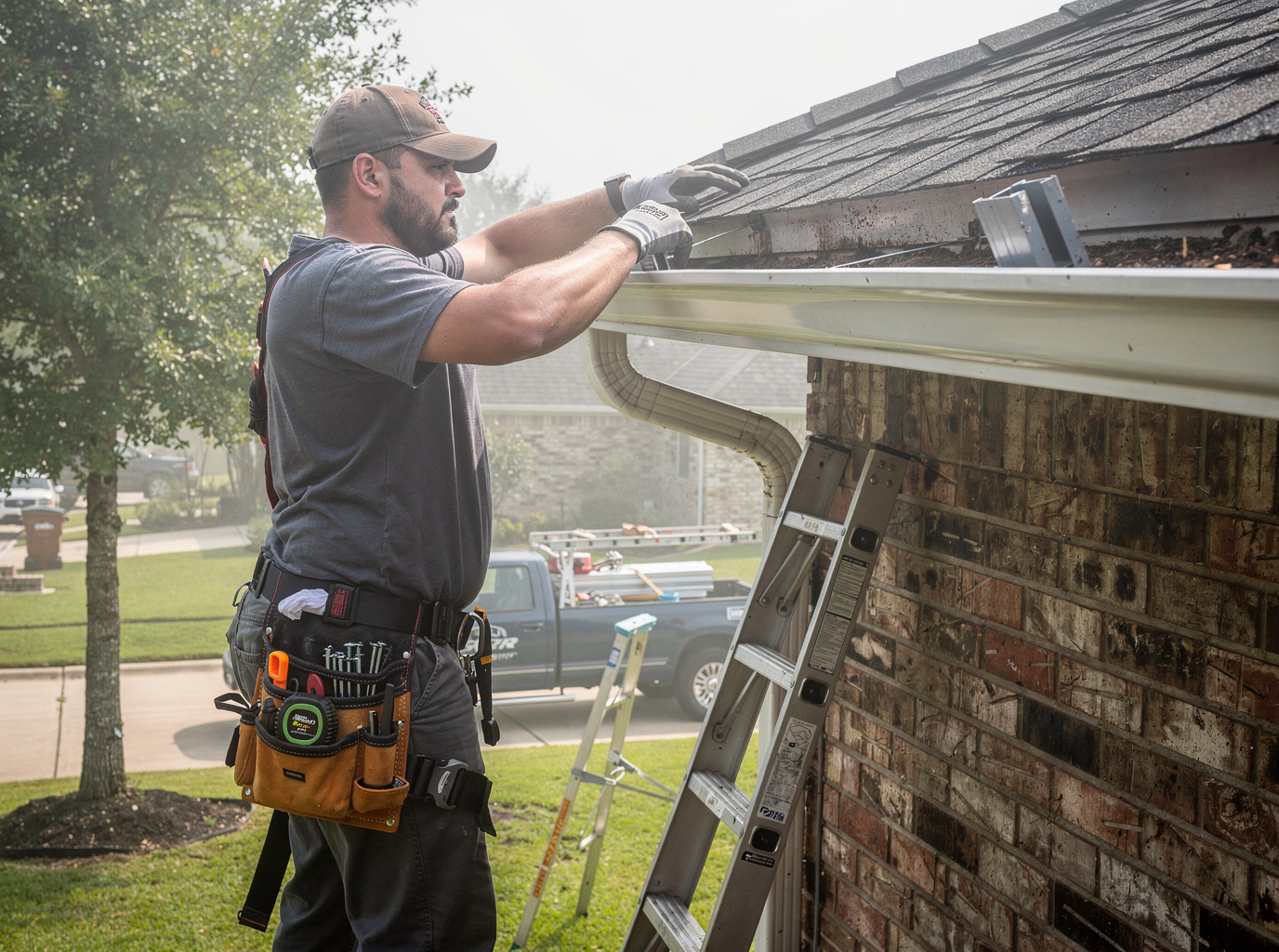
Houston's subtropical climate brings intense summer downpours that quickly expose undersized or poorly pitched gutters on homes built before the 1980s. In neighborhoods like the Heights and Montrose, many bungalows and two-story brick houses still carry original half-round or K-style gutters that were never designed for today's storm volumes. Proper installation requires calculating roof square footage, selecting 5-inch or 6-inch profiles, and ensuring at least 1/4-inch fall per 10 feet so water reaches downspouts before it overflows.
Homes in River Oaks and Midtown often sit on clay soils that shift with seasonal moisture, so installers must anchor hangers into rafter tails rather than fascia alone. Seamless aluminum or galvanized steel runs eliminate joints that leak in the high humidity. Near Downtown and Minute Maid Park, parking and access constraints mean crews stage materials early and work around event traffic. Every job includes leaf-guard options when trees from the original lots drop heavy debris into the system.
Nearby cities such as Katy, Sugar Land, and Pearland share the same rainfall patterns but have newer subdivisions with steeper roofs. Installation there focuses on matching gutter color to modern brick and stucco while adding oversized downspouts where roof valleys concentrate flow. Across Harris County, final inspections check that extensions direct water at least 5 feet from foundations to prevent settling on expansive clay.
Technician insight
In Houston, the thing that catches most people out with Gutter Installation is the amount of rain that hits older fascia on Heights and Montrose homes during a single summer afternoon. Clay soil movement pulls standard fascia screws loose within a couple seasons, so we always anchor into rafter tails instead.
Montrose Bungalow Overflow Fix
Original half-round gutters on a 1940s Montrose bungalow overflowed during every heavy rain. We found the pitch had reversed in two sections because the fascia had pulled away from settling clay soil. New 5-inch seamless aluminum was hung from rafter tails with proper fall, and two downspouts were added to handle the roof load. The homeowner reported no overflow during the next tropical downpour.
Gutter Installation Services We Offer
✓Seamless Aluminum Gutter Installation
Custom-extruded 5-inch or 6-inch seamless runs eliminate joints that fail in Houston humidity and deliver clean lines on both historic and newer homes.
✓Residential Gutter Installation in Heights Homes
Pitch-corrected systems sized for pre-1960 bungalows, anchored to rafter tails to handle clay-soil movement common in the Heights.
✓Copper Gutter Systems for Historic Properties
Traditional half-round copper gutters installed on River Oaks and Montrose estates where architectural review boards require period-correct materials.
✓Downspout Extension and Drainage Integration
Underground extensions and splash blocks route water away from foundations on Midtown and Downtown lots where tight setbacks leave little room for surface flow.
✓Gutter Installation for New Construction in Katy
6-inch systems with oversized outlets matched to steep roof pitches and large square footage typical of new builds west of Houston.
Gutter Installation Cost in Houston, TX
| Service | Typical Range | What Affects It |
|---|---|---|
| 5-inch Seamless Aluminum | $6–$9 per linear foot | Most common choice for single-story Heights and Montrose homes |
| 6-inch Seamless Aluminum | $8–$12 per linear foot | Required on larger roofs or homes with multiple valleys in Katy and Sugar Land |
| Copper Half-Round | $18–$26 per linear foot | Historic River Oaks and Montrose properties needing period materials |
| Downspout Extensions | $75–$150 each | Underground runs or splash blocks on tight urban lots |
Ranges are typical for Houston, TX and confirmed with an exact written quote before any work starts.
How it works
- 1
On-Site Roof And Drainage Assessment
Measure every roof plane, note existing fascia condition, and check soil grade around the foundation in neighborhoods like Montrose or the Heights.
- 2
Material And Profile Selection
Recommend seamless aluminum, steel, or copper based on house age, roof pitch, and proximity to large trees common in Harris County.
- 3
Custom Fabrication And Hangar Placement
Extrude seamless sections on-site and secure hangers into rafter tails every 24 inches to withstand subtropical wind and rain loads.
- 4
Final Pitch Check And Water Test
Verify 1/4-inch fall per 10 feet, install leaf protection if requested, and run water through the full system before leaving the property.
Pricing
Upfront quotes after roof measurement; final price set by linear footage, profile size, and access conditions.